Year: 2020
Control of ripening of fruits and vegetables
Ripening process need to be controlled during handling and storage of fruits and vegetables. Ripening process need to be hastened when there is high demand in the market and ripening process need to be controlled or delayed when there is no demand in the market. Precooling, Changes in atmospheric composition, temperature manipulation, hypobaric storage and irradiation are common practices in controlling the ripening process.
Climacteric fruits and Ethylene
Climacteric fruit normally ripe after harvest, have higher ethylene production rate response with applied ethylene and result faster and more uniform ripening. Example; mango, apricot, banana, kiwi fruit, avocado, tomato etc. Therefore, climacteric fruits are commercially harvested at their maturity stage before onset of ripening to prevent damage and injury during handling and storage. In other hand, non-climacteric fruits do not ripe if they are harvested before they are ripen. Read more
Fruits and Vegetables : Introduction
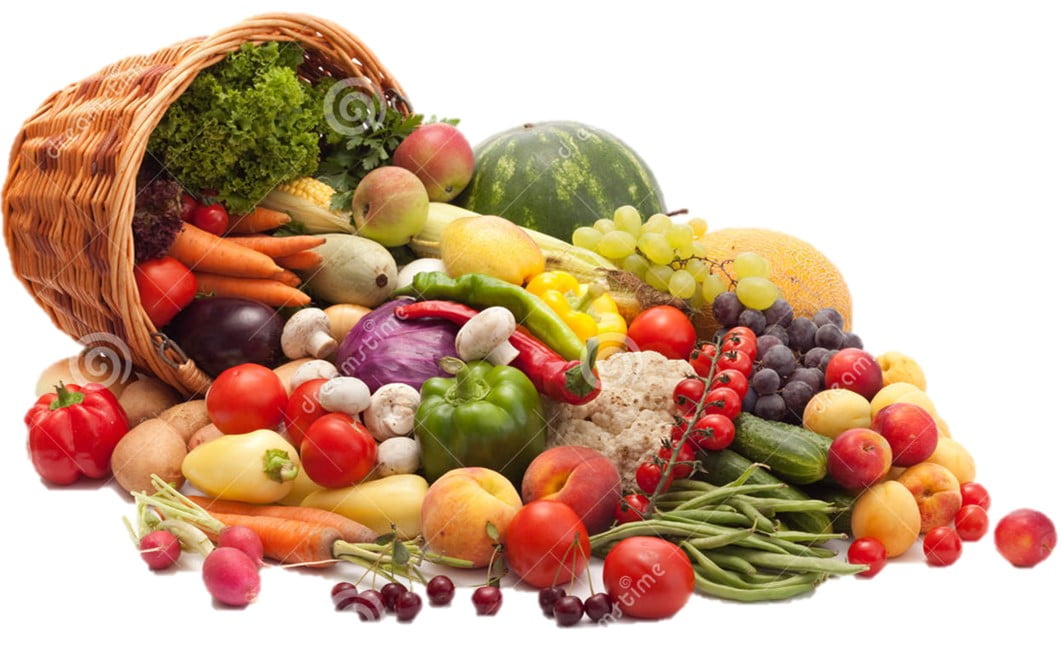
A fruit is a seed bearing part of plant and is edible when ripen and fleshy. Many vegetables may be considered fruit in the true botanical sense. Botanically, fruits are those portion of plant which house seeds. Therefore, items such as tomatoes, cucumber, peppers etc. would be classified as fruit on this basis. However, important distinction between fruit and vegetable lies on usage basis. Those items that are generally eaten with main course of meal are considered vegetables. Those that are commonly eaten as deserts are considered fruits. Vegetables are derived from different parts of the plants. Read more
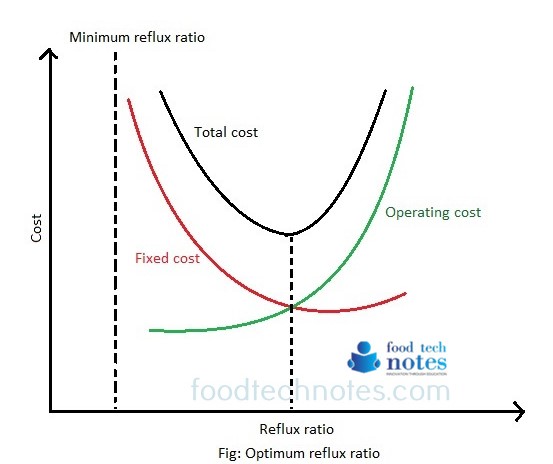
Minimum Reflux (infinite no. of plates)
At any reflux less than total, the number of plates needed for given separation is larger than total reflux. The number of plate increases continuously as reflux ratio is decreased. As the ratio becomes smaller, no. of plates required becomes very large and at definite minimum reflux ratio, number of plate become infinite.
This minimum reflux ratio can be defined as the reflux ratio (Rm) that will require infinite no. of trays for given desired separation of XD and XB. This corresponds to minimum vapor flow in tower and hence minimum reboiler and condenser sizes. Read more
Total Reflux (minimum no. of plates)
The total reflux condition represents operation with no product removal. All the overhead product is condensed and returned as reflux. Consequently D = 0 and reflux ratio becomes infinite. (RD = L/D = ∞). This in turn, makes the operating line, 45° line where V = L and slope = 1. The operating line then coincides with diagonal. This condition is called total reflux. Read more